10 Best Job Boards for High-Paying Tech Jobs in Europe (2026)
All posts | Sep 22, 2026 | Felix Gerschau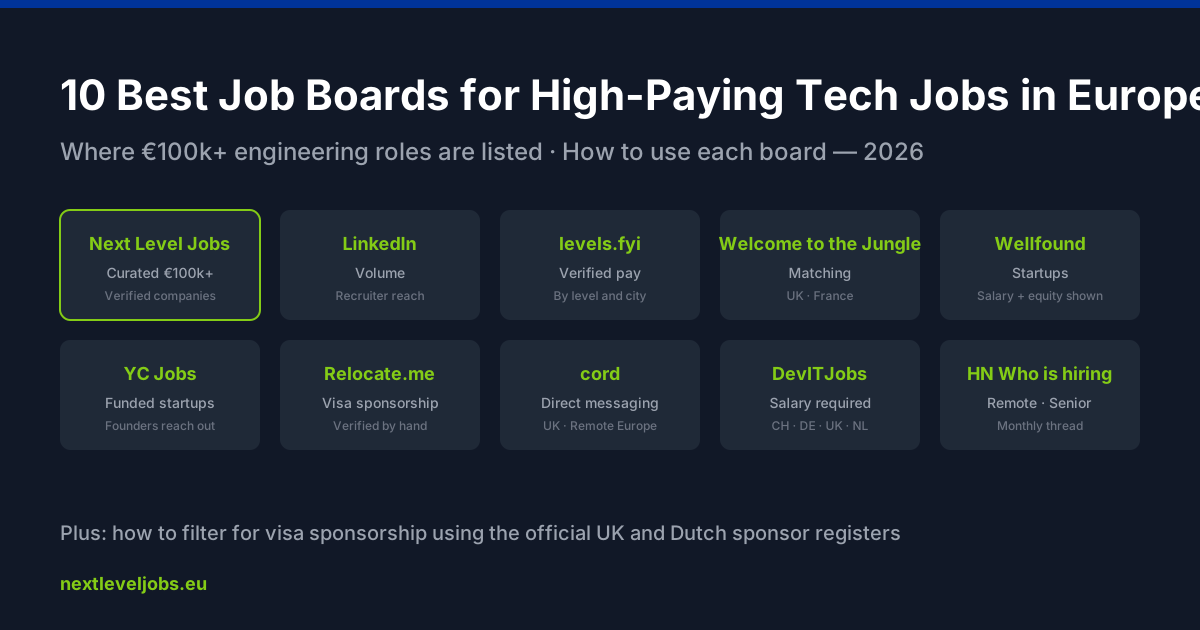
Last checked: September 2026
Most job boards are built for the companies that pay to post on them, not for the engineer doing the searching, so the €100k+ roles you want are buried under recruiter reposts and listings with no salary. This is a working list of the boards worth your time for a well-paid engineering job in Europe, checked September 2026. "€100k+" means the local equivalent throughout, think CHF 130k+ in Switzerland or roughly £100k+ in the UK.
Next Level Jobs is our own board, and it is on the list below; I have tried to be as clear about its limits as about everyone else's. A board made the cut if it reliably surfaces senior roles at that level and is still active; what did not make it is in "What's not on this list".
TL;DR: which board for what
- €100k+ roles, curated: Next Level Jobs: every company verified to pay senior engineers €100k+, scraped from career pages daily
- Volume and recruiter reach: LinkedIn: use precise filters and keyword searches, never "Easy Apply" alone
- Know the pay before you apply: levels.fyi: verified compensation by level and city, plus a job board
- Product companies in the UK and France: Welcome to the Jungle (formerly Otta)
- Startups with equity: Wellfound and Work at a Startup (Y Combinator): salary and equity ranges shown up front
- Visa sponsorship and relocation: Relocate.me, plus the official UK and Dutch sponsor registers (see the visa section below)
- Talk to the hiring manager: cord: direct messaging with hiring managers, mostly UK
- Salary-transparent local boards: SwissDevJobs, GermanTechJobs, DevITJobs.uk, DevITJobs.nl
- Remote and niche senior roles: Hacker News "Who is hiring?": monthly, searchable
- Short on time: Skip to "A search routine that works" at the end: five steps, a few hours a week
1. Next Level Jobs — curated €100k+ roles across Europe
Next Level Jobs exists because of the problem in the first paragraph. It is a job board that lists only companies that have been manually verified to pay senior engineers €100k+ (or the local equivalent) in Europe. Roles are scraped from the companies' own career pages every day, so there are no recruiter reposts and no sponsored listings, and the board is funded by engineers who pay for email alerts rather than by companies paying for placement.
Best for: Senior, staff and engineering-management roles at companies you may not know pay well: trading firms in Amsterdam, scale-ups in Berlin, US companies' Dublin and London offices, and remote-first companies with EU entities.
Cost: Free to browse. Email alerts are the paid part, priced at €39 every 3 months, or €149 once for lifetime access.
Where it falls short: Volume, compared with LinkedIn. Over 120 companies have active postings at any given time (more than 2,000 open roles combined, across almost 30 European countries), out of a wider roster of over 130 vetted companies. That is far fewer than LinkedIn, because unverified companies are not listed at all. It also skews senior. There are junior roles, but €100k+ at junior level is rare in Europe, and the board does not pretend otherwise.
How to use it well: Start from the page that matches your constraint rather than the homepage: by country (for example jobs in the Netherlands or Germany), by role (backend, machine learning), by seniority (senior) or remote across EMEA. Each company has a profile explaining why it is on the board and what it pays. The company directory is a good place to build a target list. Then set an alert for your filter so new roles reach you the day they go live, before they surface on aggregators.
2. LinkedIn — volume, and where recruiters find you
LinkedIn is not built for finding high-paying roles. It is, however, the single largest source of tech listings in Europe and the place where most in-house recruiters do their sourcing, so ignoring it costs you the inbound side of a job search entirely. Treat it as two separate tools: a profile that recruiters find, and a search engine you drive with very specific inputs.
Best for: Being approached for roles that are never posted, and for finding openings at companies that only post on LinkedIn and their own site.
Cost: Free. Premium is not necessary for a job search; the "see who viewed your profile" and InMail features rarely change outcomes for engineers.
Where it falls short: Listings without a salary. LinkedIn does not require one outside a few markets, so a title that sounds senior may pay €60k. Check the company on levels.fyi (next on the list) before spending an evening on the application.
How to use it well: Turn on "Open to work" visible to recruiters only, and put your target cities in the location field. Recruiters search by location before anything else. When searching, combine the "Past 24 hours" filter with the experience-level filter and use quoted keywords rather than titles: searching for "visa sponsorship", "relocation" or a specific stack like "Rust" "Kafka" inside the description finds roles that generic title searches miss. Skip "Easy Apply" for anything you care about: apply on the company's own careers page, where the application actually lands in the ATS the hiring manager reads.
3. levels.fyi — know what a company pays before you apply
levels.fyi started as a compensation database and has grown a job board on top of it. The database is the reason to use it: verified, self-reported total compensation broken down by company, level and city, which is the only reliable way to answer "is this a €100k company or not" for a name you do not recognise.
Best for: Deciding where to apply and what to ask for. Its Europe pay heatmap is the fastest way to compare cities, and the company pages show exactly how much of a package is base, equity and bonus.
Cost: Free for salary lookups and the job board. There is a paid tier with more detailed data and negotiation support.
Where it falls short: Coverage. Data is deepest where big tech is (Zurich, London, Dublin, Amsterdam) and sparse for smaller local companies, so a missing entry is not a signal either way.
How to use it well: Look up every company before you apply and again before you negotiate. Note the level attached to the numbers. A "senior" title at one company maps to a different level elsewhere, and the difference between L4 and L5 at Google Zurich or Amazon Dublin is often €40k+.
4. Welcome to the Jungle (formerly Otta) — product companies in the UK and France
Otta built a genuinely good matching product for London tech jobs; Welcome to the Jungle acquired it in January 2024 and retired the Otta brand later that year. The matching engine survived the move. You tell it what you care about (stack, company stage, salary floor, remote policy) and it ranks a curated set of companies against that, which is a better experience than scrolling a feed.
Best for: Engineers targeting the UK or France, the two deepest markets on the platform, at product companies and scale-ups.
Cost: Free for candidates.
Where it falls short: Depth outside the UK and France. Coverage in Germany, the Netherlands and Spain exists but is thinner.
How to use it well: Set the salary floor in your preferences to the number you actually want; the matching quietly improves once it stops showing you roles below it. Many listings carry a salary range, and the company pages are heavy on office photos and culture, useful for a sense of the team, but it means a slick page is not a signal of pay.
5. Wellfound — startups, with salary and equity in the listing
Wellfound (the former AngelList Talent) is where a large share of venture-backed startups post, and its distinguishing rule is that most listings show a salary range and an equity range up front. For European startups, which are otherwise coy about pay, that alone makes it worth a profile.
Best for: Engineers who want equity upside and are comfortable with the risk that comes with it. Strong remote coverage. Its remote section is one of the larger ones in tech.
Cost: Free for candidates, always.
Where it falls short: Seed-stage noise. Most €100k+ roles here are Series B and later, so unfiltered browsing surfaces a lot of early-stage postings with low base.
How to use it well: Filter by location (Europe, or a specific city) and set the minimum-salary filter rather than browsing. Read the equity number as a percentage of the company, not a euro figure, and ask about valuation and strike price before you rely on it. Use the company-stage filter to skip seed-stage postings unless you are explicitly looking for those. If you need a visa, the "Immigration" filter limits results to companies that say they can sponsor one, and founders often message candidates directly, so keep your profile specific about stack and city.
6. Work at a Startup (Y Combinator) — well-funded early-stage teams in Europe
Y Combinator runs a job board for its portfolio companies called Work at a Startup, and Europe now has enough YC companies (London, Berlin, Paris and Amsterdam in particular) that the Europe view is worth checking on its own. Listings show salary and equity ranges, and the companies are by definition funded.
Best for: Engineers who want to join a small team very early, at companies with a US-style approach to compensation and equity.
Cost: Free. You create a profile and founders reach out.
Where it falls short: Stage. The newest batches are hiring their first engineers on higher equity and lower base; the roles that clear €100k in base are mostly at companies two or three years out.
How to use it well: Filter to software engineering and Europe, then look at the batch year before anything else. Many roles are remote within Europe or hybrid in London; the pay band is often set in dollars and benchmarked to US norms, which usually lands above local European bands.
7. Relocate.me — roles that come with visa sponsorship and relocation
Relocate.me is a niche board for tech roles where the employer has publicly committed to relocation support or visa sponsorship. Each listing is checked by hand against that. There is no other board that does this reliably since Stack Overflow Jobs shut down, and its weekly newsletter (The Global Move) collects around a hundred relocation-friendly roles at a time.
Best for: Engineers outside the EU who need sponsorship, and EU citizens who want a relocation package to move within Europe. Germany, the Netherlands, the UK and Spain are consistently well covered.
Cost: Free for candidates.
Where it falls short: Volume. It is a niche board, so the number of open roles on any given day is small; the value is the company names, not the listings.
How to use it well: Use it to find which companies sponsor, not just which roles are open right now. Sponsorship is a company-level decision: if a company sponsored last quarter, it will sponsor the role that opens next month, even if that listing never mentions it. Combine the company names you find here with the official sponsor registers in the visa section below, then apply to those companies through their own careers page.
8. cord — direct messaging with the people hiring
cord flips the usual model: instead of applying into an ATS, you message the hiring manager or an in-house recruiter directly, and they message you. It started in London, and salary is shown on listings.
Best for: Senior engineers who interview well and want to skip the CV screen. Strongest in London fintech and scale-ups.
Cost: Free for candidates; companies pay.
Where it falls short: Geography. Listings are still mostly UK-based, with only some remote and international roles.
How to use it well: Write a short, specific opening message: what you have built, what you want next, and one question about the role. Hiring managers on cord respond to that far more than to a generic "I am interested". Because the platform is paid on the company side, the companies that are on it tend to be serious about filling the role quickly, which is useful when you are running several processes in parallel.
9. SwissDevJobs, GermanTechJobs and the DevITJobs network — salary-transparent local boards
SwissDevJobs was built by engineers who were tired of listings without salaries, and it requires a salary range on every posting. The same team now runs GermanTechJobs, DevITJobs.uk and DevITJobs.nl, all with the same rule and the same structured tech-stack filters.
Best for: Engineers who have already picked a country and want local companies (banks, insurers, industrial groups, agencies) that never post on international boards. In Switzerland in particular, this is where you find the CHF 130k+ roles at companies that are not Google.
Cost: Free for candidates.
Where it falls short: Reach. It is local by design: four countries, and employers that never post internationally, so it does nothing for a pan-European search.
How to use it well: Sort by salary and filter by stack. It works because every listing has both. The Swiss board has a "visa sponsorship for non-EU residents" filter, which matters because the Swiss B permit is quota-based and only some employers will go through the process. Germany is more straightforward; the visa section below covers the Blue Card route.
10. Hacker News "Who is hiring?" — remote and niche senior roles
On the first weekday of every month, Hacker News posts a "Who is hiring?" thread and companies reply with a few hundred plain-text job posts. It is not a job board in any conventional sense, and that is the point: the companies posting are engineering-led, often remote-first, and often hiring for exactly one senior role they cannot fill through recruiters.
Best for: Remote roles, infrastructure and systems work, and small companies with high pay and no employer brand. Many posts list compensation because the audience expects it.
Cost: Free.
Where it falls short: Format. It is a plain-text thread with a few hundred replies and no filters, so it is unusable without a search front end.
How to use it well: Do not read the thread top to bottom. Use a search front end such as hnhiring.com to filter by keywords like "REMOTE", "EU", "Berlin" or "visa". Reply by email, to the address in the post, with two or three sentences that show you read it; the person reading replies is usually the engineering manager. Check the previous two months' threads too. Roles posted there are often still open.
The board nobody lists: company career pages
Every board above is downstream of the same source: the company's applicant tracking system. Most European tech companies run their careers page on Greenhouse, Lever, Ashby or Workday, and those systems expose public job pages that search engines index. That makes a surprisingly effective "job board" out of a search query.
Try a search like site:boards.greenhouse.io "Amsterdam" engineer, site:jobs.lever.co "Berlin" senior or site:jobs.ashbyhq.com "London" staff engineer. You will find roles that have not yet been syndicated anywhere, at companies that do not pay for job-board placement. Once you have a list of target companies, bookmark their careers pages and check them weekly. Applying there directly, rather than through an aggregator, is also what gets your application in front of a human fastest.
What's not on this list
Indeed and Glassdoor have LinkedIn's volume without the recruiter inbound, so they are not worth the time. talent.io, a reverse-marketplace similar to what Honeypot was, strongest in France and Germany, is also left off deliberately: it went through a financial restructuring in 2024 to 2025 that changed its ownership, and the roles it surfaces skew mid-market rather than reliably €100k+. A few boards that used to be on lists like this no longer exist: Honeypot shut down at the start of 2025, and Hired was folded into LHH Recruitment Solutions in mid-2024 with its standalone brand retired.
How the boards compare
Strongest coverage
UK, DE, IE, PL, NL and ~25 more countries, remote EMEA
Salary shown
Every company verified at €100k+
Visa sponsorship: Country guides (8 countries); no listing filter
Strongest coverage
All of Europe (largest reach)
Salary shown
Rarely shown (required on many UK listings)
Visa sponsorship: Keyword search only
Strongest coverage
Deepest where big tech is: Zurich, London, Dublin, Amsterdam
Salary shown
Verified, by level and city
Visa sponsorship: No
Strongest coverage
UK and France (deepest); DE, NL, ES thinner
Salary shown
On many listings
Visa sponsorship: Filter for some markets
Strongest coverage
UK, DE, remote
Salary shown
Range + equity on most listings
Visa sponsorship: Sponsorship filter
Strongest coverage
UK, DE, FR, NL (YC hubs)
Salary shown
Range + equity shown
Visa sponsorship: Case by case
Strongest coverage
DE, NL, UK, ES
Salary shown
Sometimes
Visa sponsorship: Verified by hand
Strongest coverage
UK (mostly London)
Salary shown
Shown on listings
Visa sponsorship: Filter
Strongest coverage
CH, DE, UK, NL
Salary shown
Required on every listing
Visa sponsorship: Filter for relocation
Strongest coverage
Remote-first, global
Salary shown
Sometimes
Visa sponsorship: Search the thread
Finding roles with visa sponsorship
If you need a work permit, the most useful shift is to stop searching for listings that say "visa sponsorship" and start searching for employers that are set up to sponsor. Whether a company can sponsor you is a property of the company, and in several countries it is public information.
- United Kingdom: the Home Office publishes the register of licensed sponsors as a downloadable list. If a company holds a Skilled Worker licence, it can sponsor you; if it is not on the list, it would have to apply for one first, which most will not do for a single hire. Cross-reference any London company you find on the boards above against it before you apply.
- Netherlands: only IND-recognised sponsors can hire on the Highly Skilled Migrant permit, and the IND publishes the public register of recognised sponsors. Almost every company on our Netherlands visa sponsorship guide is on it, and the guide covers the salary thresholds and the two-week processing time.
- Germany: there is no sponsor register because there is no sponsor licence. Any employer can hire you on an EU Blue Card as long as the offer clears the salary threshold, which most €100k+ roles do by a wide margin. The bottleneck is whether the company is willing to wait for the permit. Our Germany guide lists companies that regularly do, and explains the Blue Card process.
- Ireland: the Critical Skills Employment Permit is employer-sponsored, and the US tech companies with Dublin headquarters use it routinely. See the Ireland guide for the companies and thresholds.
- Elsewhere: we have guides for France, Sweden, Poland, Portugal and Switzerland.
On the boards themselves: Relocate.me verifies sponsorship by hand, Wellfound and the DevITJobs boards have a visa-sponsorship filter, and on LinkedIn and Hacker News you search the text for "visa", "sponsorship" or "relocation". If you are still deciding which country to target, the comparison of Amsterdam, Berlin, London, Dublin and Zurich weighs salary against visa difficulty for each.
A search routine that works
Using all ten boards every day is a full-time job. This is the routine that gets the most out of them in a few hours a week:
- Build a target list of 20 to 30 companies that are verified to pay what you want. Use levels.fyi, the €100k+ company lists and the company directory. If you need sponsorship, filter that list against the sponsor registers above.
- Set alerts instead of searching. One curated alert (Next Level Jobs, filtered to your country and role), one LinkedIn alert with a keyword search, and the Relocate.me newsletter if you are relocating. Let the roles come to you.
- Apply on the company's site, even when you found the role elsewhere. Aggregator applications are frequently lower priority in the ATS, and some never arrive at all.
- Check the level, not the title, before every application and every negotiation. A "senior" role at one company is an L4 elsewhere; levels.fyi tells you which.
- Run processes in parallel. Two or three offers arriving in the same fortnight is the single biggest lever on compensation you have. cord, Wellfound and Y Combinator move fast; large companies do not, so start those first.
If you want a sense of which stacks are pulling the highest offers right now, the in-demand languages for 2026 post maps languages to the companies and salary bands hiring for them.
Frequently asked questions
Which job board is best for high-paying tech jobs in Europe?
There is no single best board. The right combination is a curated board that filters by pay (Next Level Jobs for €100k+ roles), one large aggregator for volume (LinkedIn), and levels.fyi to verify what a company actually pays before you apply. Add Relocate.me if you need visa sponsorship, and Wellfound or Work at a Startup (Y Combinator's job board) if you want startup equity.
How do I find tech jobs in Europe with visa sponsorship?
Filter by employer, not by listing. The UK publishes its register of licensed sponsors and the Dutch IND publishes its register of recognised sponsors. If a company is on the list, it can sponsor you. Germany has no sponsor register; the visa section below covers the Blue Card route. Boards like Relocate.me verify relocation support by hand; on LinkedIn, search for 'visa sponsorship' or 'relocation' as keywords in the job description.
Are paid job boards worth it for software engineers?
Only if the paywall funds curation you cannot get for free. Every board on this list is free for candidates, apart from Next Level Jobs' optional email alerts, which exist so the board runs without sponsored listings. Paying for access to a generic aggregator's listings is rarely worth it, because the same roles are on the company's careers page.
Which job boards show salaries for tech jobs in Europe?
levels.fyi (verified, self-reported compensation), Wellfound (salary and equity ranges on most listings), SwissDevJobs, GermanTechJobs and the rest of the DevITJobs network (salary ranges required on every posting), and Welcome to the Jungle for a growing share of its UK listings.
Is LinkedIn still worth using for tech jobs in Europe?
Yes, for volume and for recruiters finding you. No other platform comes close in reach, and ignoring it costs you the inbound side of a search. Listings rarely show pay and 'Easy Apply' roles attract hundreds of applicants, so treat search results as a lead list to verify elsewhere, not a shortlist to apply from directly.
How do I find remote tech jobs in Europe that pay well?
Remote roles that pay €100k+ almost always come from companies with a legal entity in your country or from remote-first companies that pay on a global band. The monthly Hacker News 'Who is hiring?' thread and Wellfound's remote filter are the best places to start. Check whether the role is 'remote within country', 'remote in EMEA' or 'remote anywhere'. The pay band usually differs.